While most altcoins are getting slaughtered, LTC shines propelled higher by Litepay and a new fork. Bitcoin continues its gains as well but stopped short of a new rally. Bitcoin Higher but Stops Short of New Rally Bitcoin prices traded even higher si...
Community Directory
- 8,007 Profile views
- 13 Articles Published
- 126 Forum Posts
- Email: [email protected]
- Real Name: mike ward
- Location: orphaned block
- Website: http://mdw.github.io
Bio:
Blockchain fanboy here. More chain, we need more chain!!!
- Bitcoin Tipping Address (This is not your LTBCOIN address): 1mdw2vT7Bxg11krvKGHLFSh8PkPXUY5Lb
User Activity
Blog Posts
- Posts Authored: 13
- Posts Contributed To: 0
-
Intro to Decentralized DNS
August 4th, 2014 by
mike ward The Domain Name System (DNS) is the Internet's version of a phone book, allowing computers to lookup an IP address like 66.175.222.204 from a given domain name like letstalkbitcoin.com. Today's Domain Name System is sagging under the heavy weight of political and technical problems. It has held fast for years, but worsening technical issues and growing concern over governance seem implacable in a system designed with centralized control.
In this series of articles we intend to examine the key issues more closely, and look at specific initiatives in the crypto-currency space designed to alleviate the pain points or create new opportunities. We will be outlining some of the next generation DNS alternatives being built, and talk with some of the visionaries making it happen.
But first, it is important to identify what the most serious problems really are. Which ones are intrinsic problems that any distributed naming system will exhibit? Which ones are shortcomings of centralized systems, such as we currently have?
Freedom of Speech
In most parts of the world speaking out against government censorship, corruption, or government policies is a risky proposition. By speaking out, we refer to publicly voicing dissenting opinions, published on a website for the whole world to read.
In a world where thought leaders can keep a low physical profile, electronic censorship has become the de facto weapon of choice in the suppression of ideas and ideology. Mass access to these voices, and the censorship thereof both rely on using domain names.
Today domain names are routinely seized for various reasons. Sometimes people are indifferent, or even supportive of this - in the case of child pornography websites for example. Sites filled with hate speech, promoting violence against ethnic, religious, racial, or other minorities are routinely taken down via domain seizures. Registrars are only too happy to comply with governments to minimize citizens' exposure to the ugliness that is hatred and bigotry.
But this is a slippery slope. It is not clear that the system benefits us all when the censorship occurs because content is alleged to be in violation of copyright law or politically threatening. Is seizure of domain names justified when sites are being used to spread malware? Is revolutionary speech too destabilizing, and when can it safely be tolerated? The answer of course, is highly subjective.
Privacy
Over the years, the Internet Corporation for Assigned Names and Numbers (ICANN) has developed processes for making decisions which are highly inclusive of a range of stakeholders. Unfortunately the loudest voices get a disproportionate share of influence, and this has contributed to an erosion of privacy for domain registrants.
Information about who is the registrant of record for a given domain name are currently accessible via a mechanism called WHOIS. ICANN requires this information, and the penalty for non-compliance or falsifying the info can be domain seizure. This is very convenient for corporate holders of intellectual property rights, in order to identify and go after those who are perceived to be infringing on those rights.
There is a strong case to be made against requiring such disclosure from registrants. However, ICANN's Expert Working Group on WHOIS and Privacy recently published their report recommending the expansion of WHOIS in a way which further weakens privacy for individual registrants by requiring and exposing street address and phone number data.
Internet Security
Identity is at the heart of many online security challenges. "Who is that, and should I trust them?" is the most basic concern in many interchanges on today's Internet. Indeed, identity and reputation management are considered by some to be the holy grail of social interactions on the Internet.
As users interact with websites which offer services and information, each side tries to determine the likelihood that the other is sufficiently identified, and that the interaction will be conducted safely. A potpourri of technologies is employed to accomplish this today, which is another way to say that we struggle mightily.
Trust on the web today is primarily established using digital server certificates. The entity at the other end, with whom users interact, establishes a basis for trust by providing one of these. It will be signed by an even more trustworthy certificate authority. In case it is not yet evident, this system if fraught with peril and requires a lot of trust. The current system has proven over time to be untrustworthy.
Another area of concern is the control structures. Registry operators are the authorities for top level domains like .COM. Root servers are those lynchpins which contain the authoritative DNS data for resolving domain names. They are both prime targets for attack, as well as central points of failure. There are other central targets in the system as well, including ICANN itself, which guards a private key used to sign certificates for these root servers.
Domain Thefts
Aside from the domain seizures that routinely occur, the risk of theft is always present in the current domain name system. The classic scenario is the compromising of a victim's registrar account along with an email account. The specifics could involve keystroke loggers, social engineering to access registrar accounts, registrar employee collusion, or plain old inadequate password management on the part of registrants or registrars.
However it happens, when registrar accounts are compromised, the domain names are typically transferred to countries with less mature judicial systems, or less cooperative political leadership leaving the victims with little or no recourse.
Assets secured on a blockchain work differently. Transferring control of assets involves presenting private keys. That is all. No password management, hacking servers, etc. The security of such an asset is completely up to the person controlling the private key.
More Problems?
There are other shortcomings to the current domain name system. But we have outlined enough here to give our readers a sense of where we expect to see blockchain-based solutions making inroads.
Big changes are coming to the domain name system as we know it today. Our current system has been in place since the 1980's, and is ripe for change. In fact people have been working on blockchain based remedies and replacements for this thirty year old system that we have come to depend on.
What will our global namespaces look like a few years from now? How similar will these systems be to our current one? Stay tuned as we bring you the ideas of some key visionaries who seek to rework this aging system.
Read More -
Our Fractious Bitcoin Community
July 29th, 2014 by
mike ward There are growing divides among the ever increasing numbers of supporters of Bitcoin. These schisms have existed since the very early days of this technology. Yet people were compelled historically by a common vision to band together and push forward as a united movement.Bitcoiners hold a wide range of views about why Bitcoin specifically, and cryptocurrencies generally, are exciting. Initially these divergent opinions were suppressed in favor of universally supported goals, but as the Bitcoin ecosystem continues to mature that bond grows weaker.
In the Beginning There Were Techies
First there were the technophiles. Satoshi and his contemporaries having lofty discussions about how to make digital currency technology work. How specifically to create a system like hashcash or bit-gold without the double-spend problem? It’s not clear that even they realized the import of what resulted from those discussions.The techies continue to be fascinated by new algorithms for securing the network, experimentation with sidechains or tree chains, meta protocols using Bitcoin’s blockchain as substrate, new approaches to anonymity, next-generation 2.0 metachains, and all the new and shiny advances that come along.So the techies came first. Who else could understand why this Bitcoin would work where previous iterations had not? Who else would setup machines to "mine" these worthless digital things? Technologists create; if it has value, others may follow.Geeks soon began to realize this weird idea of a blockchain as a mechanism to achieve consensus across a distributed network had merit. It wasn’t simply an inefficient, sloppy way to do data storage. It was, in fact, a solution to a classic problem in computer science involving ensuring data integrity on a network without requiring the trusting of any specific node. They quickly began to think of other applications, like de-centralized domain name systems and more.Many of them began mining what would eventually turn into fortunes. This led to the inevitable first exchange of value involving Bitcoin, the famous 10,000 BTC pizzas, which would become a cherished part of Bitcoin history.And Then Came Progressives
Read MoreAfter living through the financial mess of the previous decade, many young idealists soon began to wonder if this weird digital money could provide some degree of freedom from the encumbrance of the traditional world of finance. An influx of counter-culture advocates flocked to Bitcoin, but were more diverse in their worldview than the original money hackers.These early adopters included a fair number of Libertarians, who found appeal in the idea of usurping government control over existing, corrupt financial systems. They pointed to the big banks, repeatedly sanctioned for market tampering, money laundering, rigging rates, fraud and more. They were disgusted that these same institutions could receive billions in public bailouts when their dubious investments went belly up. Worse still, these huge banks and financial firms continued to engage in the same behaviors, merely paying fines every time they got caught.This group of early adopters also included self-proclaimed agorists, who rallied behind the notion that they could avoid letting governments know anything about their money, and avoid supporting it with their participation, and avoid paying taxes. This contingent included everything from living-off-the-grid isolationists to fiercely independent separatists.
Success Has a Downside
Of course as Bitcoin the currency started to be valued in the nascent marketplace, it attracted the attention of criminals. Criminal enterprise is an indicator of success in the case of currencies. The US dollar is going to remain the preferred currency of criminal organizations for now, but new opportunities emerged for the unsavory elements in our midst to conduct business across distances using Bitcoin.The dark web became filled with Bitcoin scammers. Governments realized they could gain credibility in the eyes of those anxious about technological change by attacking underground Bitcoin enterprises like Silk Road.Fraudsters began to emerge as well, as it became obvious that profits could be made. Some untrustworthy exchanges would repeatedly have trouble and freeze withdrawals, some would simply take deposits and disappear.New altcoins would pop up with no hint of utility, engage in marketing campaigns and then dump everything as soon as the coin gained value. Some had no programmers, some had hidden pre-mines, DaFuqcoin even deployed a trojan.And so there came to pass an uneasy alliance between many technologists, believing that algorithms can solve problems better than laws, and criminals looking for anonymity, and privacy advocates bemoaning the increasingly intrusive nature of online surveillance. This ushered in new tech like Zerocash, Darkcoin, coin mixing services, and Darkwallet.
Enter the Entrepreneurs
We then started to see a new class of technologists flocking to Bitcoin. Not the early pioneers, but more practical entrepreneurs. Some blended in perfectly, understanding the tech well at a sufficient level to bring it to main street. The result was friendlier wallets, exchanges, and tutorials.But the entrepreneurs working in the financial services space quickly realized they needed what others in the growing community were stridently opposed to. To build real exchanges in the post-Gox era, for example, required quantifying legal and regulatory risk. Business opportunities depend on predictability.Uncertainty is the worst environment for financial services; clearly spelled out governmental policies, even problematic ones, would bring opportunities. So how to make others in the community understand? Broad, sweeping regulation appeals to nobody. But the intersection of fiat and crypto is the domain of those governments who control the old currencies.
The View From Main Street
Bitcoin has survived MT Gox, Silk Road busts, repeated faux-banning in China and much more without sustaining any lasting damage, and that has vindicated those who truly believed. This has ushered in still more folks from main street, who have started to call for regulation, and to ask about those safeguards to which they’ve become accustomed in life.Now they ask about services to insure deposits. They worry about the complexity, they worry about making mistakes. They wonder if the free-for-all altcoin markets would ever get some oversight. They talk about all those things that so many early adopters are so adamantly opposed to.Beyond the need for simplicity of design and function, the newly intrigued would like to participate more broadly. For that to happen requires fewer scammers and fraudsters, a wider variety of wallets and online account options, and the ability to scrutinize and audit services like online exchanges.
The Inevitable Fragmentation
The ever broadening base of Bitcoin supporters is highly democratic, and growing more diverse with each passing day. Entrepreneurs versus Agorists? Libertarians vs. Venture Capitalists? The plurality that is the Bitcoin community grows further apart with each new on boarding of users. Perhaps that’s not a bad thing.Isn’t this really what most of us wanted? Bitcoin’s becoming mainstream. So many different voices are speaking up. Did we expect dogma from a self-appointed group of thought leaders to be promulgated throughout the user base like an ancient religion? No, it only makes sense to expect a messy competition of ideas and aspirations. -
Funding Anonymity with Crypto
July 23rd, 2014 by
mike ward Proofread and edited7/21/14 denise
The Tor network is a widely used tool which provides a degree of anonymity to users. Users have their location obscured from those watching certain destinations, and what they are doing hidden from those who know their location.
But Tor has some problems, one of which is a relatively small number of people running servers on the network. These so-called relay node operators would be rewarded under schemes currently being considered, by issuing a token in exchange for proof of bandwidth provided to the network. In this article we explore how this clever scheme might work in a bit more detail.
Tor network is a unique tool on the Internet, providing a high level of anonymity to its users. Recently we reviewed a whitepaper proposing a plan to issue a crypto currency with the goal of incentivizing those key players who make it all possible. This would institutionalize a rewards structure, in the same spirit as a recently announced EFF initiative to give prizes and recognition to people who operate network nodes for twelve months.
Tor network accomplishes this difficult feat of fuzzing what users do and where they're located by routing traffic through a set of randomly chosen nodes before reaching the intended destination. This can only currently be done because people volunteer to run nodes on the Tor network. As you might imagine, there's a shortage of volunteers. The brave folks who run the more important of these network components are not only unpaid, but they face frequent attack by malicious agents, and make themselves persons of interest to the NSA.
This recent proposal aims to at least offer some small financial reward for those who will contribute to the continued operation of Tor. Network nodes who route traffic toward its destination can receive tokens for doing so, and would have an opportunity to exchange them for fiat, or bitcoins or other.Tor Terminology
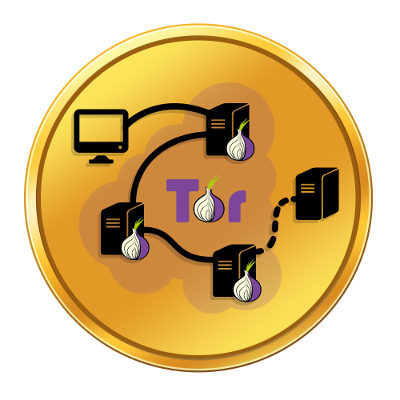
Tor network is made up of servers referred to as nodes. These servers relay information through the network, thus the moniker relay nodes, and are further categorized based on their specific roles.
Guard nodes are the entry into the Tor network. They act as the gatekeepers, but due to Tor's ingenious omion routing scheme they cannot know the intended destination - only the next hop within the network.
Exit nodes are the most important ones, sending traffic from within Tor network to the actual destination. These critical nodes are more scarce than ordinary relay nodes, largely because they are prime targets for attack. They are in a unique position to attack user sessions since they directly connect to the destination endpoint. If they are able to collude with guard nodes they can de-anonymize users, since together they will know both endpoints; e.g. who is using Tor and what they're doing.
Each trip through Tor network is called a circuit, and consists of 3 pseudorandom nodes including a guard node, relay node and exit node. These nodes are chosen from a list of active nodes provided by a Directory Server. There are very few of these, since a high level of trust is essential. These Directory Servers are also key to making the proposed incentive scheme work.So who gets the coins, how would they be issued, and what exactly gets rewarded?
The basic idea is to reward relay node operators who can demonstrate that they provided bandwidth which was used to route requests on the network. Every node interacts with at least one other node, and the nodes within a circuit can validate claims by adjacent nodes in a given circuit. Under this proposal these nodes could be rewarded with tokens, for each time they participate. A bit more information needs to be published by the Directory Servers, and nodes will need to do a little more work.
It's widely believed that NSA and other agencies run many Tor nodes, especially high speed exit nodes. The nodes with the most available bandwidth get chosen more often, and as mentioned earlier, exit nodes are in a unique position to collude and to execute man-in-the-middle attacks. It has been shown also that the NSA targets Tor users for extra scrutiny, and key players even moreso.
But before we forsake Tor, thinking it's a rigged game, it's important to realize that the facts are somewhat more confusing. Tor was built and funded by the US Navy. It's very useful for government agents conducting operations in the field with anonymity. But there are many other uses for law enforcement generally, as well as whistleblowers, political dissidents, and more.
The US Government has continued to provide most of the funding for Tor over the years, and still does. But this does not mean that it's a honeypot. There is a need to have operatives in faraway places able to interact with their colleagues inconspicuously. The fact that people hide from government suveillance, and even use the network for criminal activity does not make it less useful.
The leaked Snowden documents clearly suggest that the NSA has had mixed results trying to breach the anonymity of users on Tor. It's also clear that the more people who can be persuaded to run nodes on the network, the more anonymity is afforded to users. More guard and exit nodes mean less chance of some single entity operating both of these nodes for a given circuit. And generally the more users on a network, the harder it is to match users with destinations.Read More
Currently there are just under 6000 relay nodes on Tor network, and of those it looks like there are just over 1000 exit nodes currently. Constrast this with about 2.4 million daily users and you can easily see how more nodes are needed. Thus the impetus for creating incentives. It costs money to operate a high bandwidth node, and now we have people discussing how to best offset that cost with an altcoin. One more victory for blockchain tech!


2,175 views