Editor: Chulseapple
Original:
The security of an individual Bitcoin address is well documented and an awesome mathematical certainty. But what about the security of sending Bitcoin to somebody? Is there a mythical CEO of Bitcoin somewhere, warding off would-be hackers attempting to steal your funds through a man-in-the-middle attack? What guarantees the absolute certainty of your transactions? Quite frankly, mathematics!
The Telephone Game
Do you remember the telephone game from your childhood? A big group of people, say thirty, sits in a circle. One person whispers a word or a phrase to the person next to them. That person delivers the message to the next person, and so on, until the message goes entirely around the circle. The goal is for the message to get back around to the beginning exactly the same as it started.

Why the Telephone Game Fails
In a telephone game with thirty people, there are thirty separate, singular points of failure. This is a very important point, because even though the players in this game can be honest, all it takes is just one dishonest person to wreck the honest intentions of others. If one of the players decides to be that guy and wreck the game by sharing the wrong message, no one will know who threw the game. Since each whisper transaction is peer to peer, each player puts their complete trust in the one person that came directly before them to relay the correct message.
Change the Rules!
How could we fix the rules of the telephone game to ensure that it could never fail, keeping in mind the above issues? Instead of thirty people sitting in a circle, let's start the game with only one person in the room. This person creates a message, and then another person is allowed to enter the room and hear the message. We then change the rules so that no whisper will take place between just two individuals. We bring an independent group of 100 observers to assist. This independent committee records on a piece of paper all information possibly related to that whisper, including:
- The time the whisper takes place
- The individuals involved in the whisper
- The actual message that was passed from person to person
To incentivize this supervision, $1 USD is awarded for the successful recording of each whisper transaction. Unfortunately, bringing in this independent team would be expensive, especially if we paid every single one of these 100 individuals for each whisper in the game! After all, how much skill does it really take to listen to two people talking, and record the results? Therefore, we will require the winning observer to not only be the first one to record the whisper transaction, but also the first to solve a Sudoku puzzle correctly. I am pretty sure we could have asked them to do anything to prove they were working, but I like Sudoku puzzles, so Sudoku puzzles it is!

As soon as the first lucky observer solves the puzzle, all other observers come to a consensus on who won. That person gets paid the $1 reward, and maybe even any tips the two people playing in the telephone game decide to give them for being so awesome at solving Sudoku puzzles. This new process is now not only safe to extend through the end of the telephone game with just 30 people, but also feasibly forever with an infinite amount of participants.
In fact, the only way this game could be ruined is if a majority of observers are somehow in cahoots with one another, and decide to transcribe the message incorrectly. In theory, they could pool their puzzle solving power together, coordinate a fake message, and manage to solve the puzzle correctly before the other observers manage to be the wiser. This would be like re-introducing a singular point of failure to the system because a majority of the people in the room would have the power over the message being sent.
We can fix this by inviting one thousand ... no ... one million observers to watch the whisper transaction! Good luck trying to coordinate a majority of that many people evil observers!

Would You Trust This Network?
If you had to get a message of value from point A to point B, would you trust the telephone game system I just outlined above? You ought to, because what I have outlined is essentially the Bitcoin blockchain. The blockchain is the irreversible ledger of all transactions that have ever taken place in the Bitcoin ecosystem, from one account to the next, and quite possibly one of the most significant innovations in technology of all time.
From my telephone game analogy, each person trying to get a message to the next person relates to what are called blocks on the Bitcoin network. A block in Bitcoin is a combination of three elements: the hash of the previous Bitcoin block, the Merkle root, or the hash of all of the hashes of transactions that have taken place from one address to the next in the Bitcoin system, within about a ten minute time span, and the nonce, or a completely random number unknown to anyone at the time.
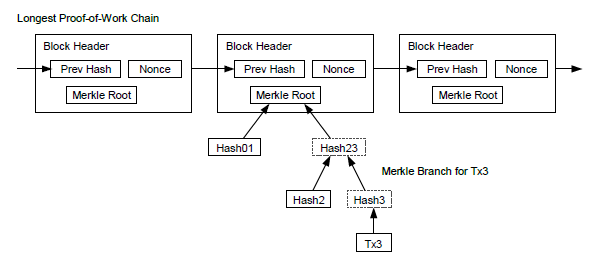
The observers of the new telephone game I proposed are what we know in the Bitcoin world as miners. Miners earn a block reward for their work in the process of hashing together approximately the last ten minutes of each transaction, in addition to any transaction fees from user to user associated with that block. Just like in the new telephone game where merely observing took little to no skill at all, hashing transactions together is just as arbitrary. Therefore, a Sudoku puzzle-like game that mandates the miners to essentially guess a very large random number was created. This very large random number is known as the nonce, and it is added to the end of the previous hash to mint a block. This nonce requires the miners to prove they dedicated a lot of computing power to work; and at the same time, introducing a little element of luck to the process.
Where Do Bitcoins Come From?
In the beginning, no Bitcoin actually existed. Therefore, there were no coins to actually send from one address to the next, and no transaction messages to be broadcast. Just like the new telephone game, the Bitcoin network could not be started until an initial message existed to be sent. This initial message to be broadcast in Bitcoin is known as the genesis block. The reward for the first miner to observe this block, or any subsequent block for the immediate future, was 50 BTC (current value: approximately 27,000 USD).
Even though there were no initial Bitcoin transactions in the genesis block, by default, every block that ever gets discovered on the blockchain has an unspent open-ended transaction called the coinbase, which is reserved for the miner who eventually wins the nonce guessing game. So, at minimum, there is one transaction that MUST happen every block, even if there are no other transactions on the network. Any other transactions on the network will be added on top of this and hashed down the size of one block. This coinbase reward that goes to the winning miner is known as the block reward. This block reward started out as 50 BTC, but subsequently has gone down over time at a predictable schedule, to match the idea of the value of Bitcoin eventually rising over time. For the first 210,000 blocks, the reward was 50 BTC, but this reward is cut in half for every 210,000 blocks after that. Currently, we are on approximately block 315,000, or a reward of 25 BTC per block.
Attack of the 51!
The more miners who are playing the Bitcoin game, the more likely someone will randomly be lucky. On average, the difficulty is designed to take about 10 minutes to go block to block. If computing power gets better, difficulty is adjusted to maintain this ratio.
What would happen if the majority of the miners pooled their brute force computing power together to attempt to disrupt the network? Could this feasibly happen? Think of it from the miners' perspective.
When your Bitcoin wallet says 2 BTC, it does not mean that they are physically there, like paper currency actually sitting in a leather wallet. Instead, those 2 BTC represent a ledger of transactions that is traceable back to the genesis block and that prove the entire history of Bitcoin leads to you having that many BTC sent to your address.
If a miner were to pool their power with a majority of bad actors on the network, they would be able to essentially go back in time on the blockchain, and forge forward an alternate history that could fake transactions and swing the ledger to their benefit. This is what is known as a 51% attack, and it can completely destroy the trust anyone has in a [cryptocurrency] (http://en.wikipedia.org/wiki/Cryptocurrency).
If you have ever seen the movie Back to the Future 2, you have seen an a 51% attack. In the plot of the movie, the chief antagonist, Biff, overhears Marty McFly in the future year of 2015, talking about taking a sports almanac back with him to the past to earn a little extra money by betting on known sporting event outcomes. Thankfully, Doc talks him out of this, but this does not stop Biff from overhearing the idea and thinking to do this himself. Biff famously steals the Delorian time machine, travels back to 1955 with the magazine, and successfully creates an alternate reality past 1955.

So what exactly stops this from happening with Bitcoin?
First, and foremost, there is not just one Biff mining Bitcoins. There are thousands of miners out there. It is true that some do merge their powers to become more powerful miners, but still, there are many of these groups. Thus, there is a distributed workforce working together in the honest process of mining Bitcoins. The probability of a single group, or even a distributed group, of dishonest miners forging past the honest miners to form an alternate reality is nearly impossible. Of course, anything is theoretically possible, but very highly unlikely, as long as Bitcoin has financial incentive to a distributed miner workforce.
Why So Revolutionary?
The blockchain accomplishes a complete, trusted flow of information that no one person is in charge of, GUARANTEED by mathematics to be genuine. In a world where one does not have to trust just one person to verify that something is true, there are truly no limitations to what can happen, or to the applications that can be created. This is why people truly get evangelical about Bitcoin, and truly believe in the power of cryptocurrency.
Imagine any application where central points of failure create controversy:
- Voting
- Banking
- Stock Markets
- Government
- Corporations
- Law
Now imagine the rules for these being completely rewritten with blockchain technology. The value of Bitcoin as a currency is important. However, the value of the protocol is limitless!
-Adam Terwilliger
New to the LTB network? Follow [this link]( http://letstalkBitcoin.com?ref=9de4636b) to let them know I sent you! While here you can earn all kinds of LTBcoin for actions you would already take, like commenting on blog posts, participating in the forums, and listening to podcasts!
Read More























3,417 views